Set a first-in-human dose you can defend
- Delivery
- Up to 6 weeks from a clean dataset
- Price
- Fixed, quoted after the call
- Typical model risk
- High
What is at stake
A starting dose that is too cautious costs cohorts and months of escalation. One that is too bold puts participants at risk. The rationale is also among the first things an IND reviewer reads.
Question of interest
What starting dose, escalation steps and maximum exposure for the first-in-human study?
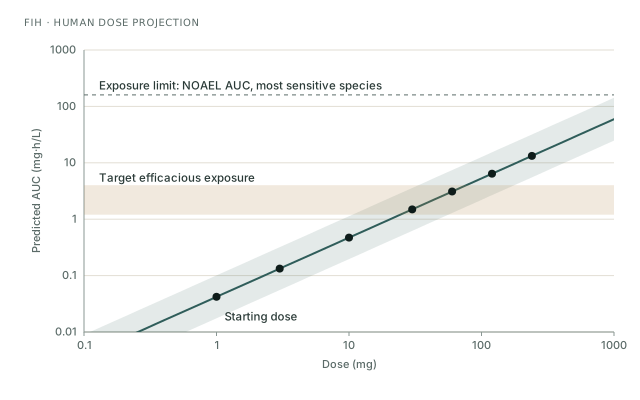
A translational model, combining allometric or PBPK-based human PK projection with nonclinical PK/PD, supports the starting dose, the escalation scheme and the exposure at which escalation stops. Nonclinical toxicology and, for high-risk biologics, a MABEL approach form the rest of the evidence.
What reviewers will ask
How sensitive is the human PK projection to the scaling method?
We compare several methods and carry their spread into the escalation scheme, rather than reporting one number and an appendix.
Is the starting dose consistent with MABEL for this mechanism?
For agonists and other high-risk mechanisms, receptor occupancy and MABEL are calculated and reconciled with the NOAEL-based dose.
At what exposure does escalation stop?
An exposure limit is set from the most sensitive species and stated for each dose level, by AUC and by Cmax.
What you file with the agency
- Starting-dose and escalation rationale for the IND or CTA
- Investigator brochure section on human PK and dose projection
- Exposure-margin table for every planned dose level
- Translational modeling report and M15 assessment table
What we need from you
- Nonclinical PK, toxicokinetic and pharmacology data across species
- In vitro data: protein binding, blood-to-plasma ratio, metabolic stability, potency
- Toxicology study reports with NOAELs, and the draft clinical protocol
What it may replace
This package does not replace a study. It informs the design of the first-in-human study: starting dose, step size and the exposure at which escalation stops.
Is this the decision in front of you?
Fixed price, paid in two milestones. A guaranteed date. Agency questions on this analysis answered at no extra cost. Pricing · How we work